Confined Space Entry — learn the risk, then check the work.
One of the most consistently fatal categories of work in industrial operations. VIRSAT trains workers to recognize the hazard and gives supervisors a way to verify the entry checklist was actually followed, every time, in the field.
Confined space entry training teaches workers to recognize fatal hazards — gas testing, isolation, standby persons, rescue readiness — before entry starts. HeadSafe then verifies the same checklist in the field, hands-free, before the permit is signed off, so the check happens every time, not just once.
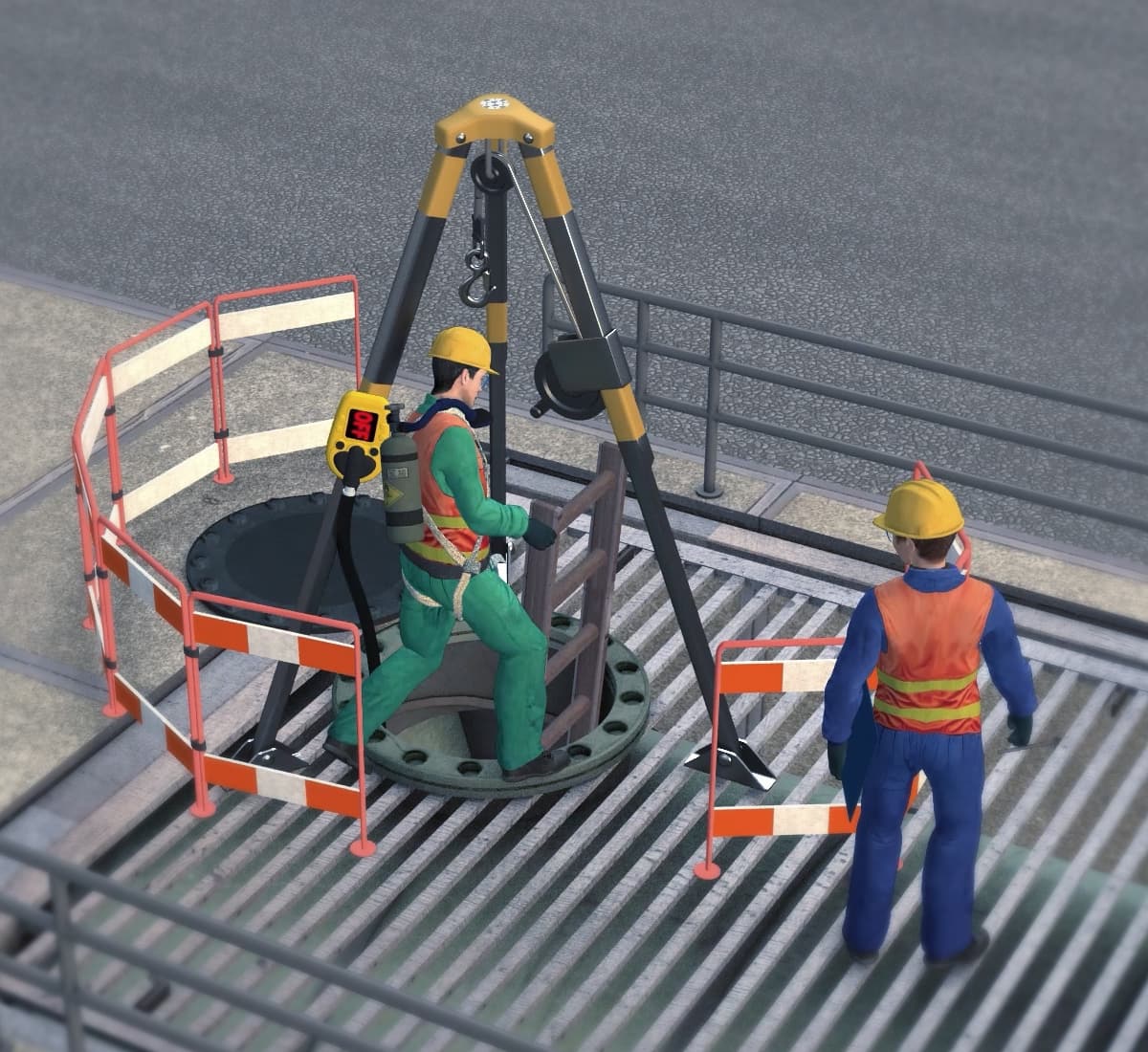
The pattern behind the incidents
Confined space entry is one of the nine IOGP Life-Saving Rules — introduced after a large-scale review of historic fatal incidents across oil & gas, construction, and manufacturing. Rules like it cover roughly 70% of fatal activities in these industries, and compliance with them is the single largest lever operators have pulled to bring fatality rates down.
Learn it once. Check it every time.
Confined Space Entry gets the full two-phase treatment — a training module that builds recognition and judgment, and a HeadSafe check that verifies the entry procedure in the field.
Covered in the basic workplace HSE training
Confined space entry isn't taught as a standalone course — real incidents rarely involve just one hazard. A worker in a confined space may also be working at height, or exposed to a lifting operation overhead. So VIRSAT's basic training covers all nine fatal-risk topics together, confined space entry included, in one module.
- —Awareness level: a fast, gamified format for broad workforce reach
- —Professional level: a full virtual reality operational environment
- —Builds hazard recognition and intervention skill, not quiz recall
- —Audio-led — no reading required, runs in any supported language
Confined Space Entry — HeadSafe verification
A hands-free AR checklist for the entry itself, built on an industry standard start-work checklist — used by whoever is preparing the permit, starting the work, or auditing it in the field.
- —Same hazard categories as the training, with field-level granularity
- —Voice-controlled — no gloves off, no paperwork
- —Results log automatically against the permit record
Explanatory animations
Contextual help
AI assistant on your manuals
Live expert support
The real Start-Work Check, item by item.
This is the actual checklist HeadSafe walks a worker or Start-Work Verifier through before confined space entry begins — confirmed hands-free, with a signature captured at the end.
The confined space has been evaluated for energy isolation requirements — if isolation is needed, that check is completed first.
▸Hazards have been identified, controlled, and it's safe to start.
▸Gas testing frequency has been established.
▸Ventilation is in place and working.
▸An attendant is in place, with a tested and agreed method of communication.
▸Breathing apparatus is confirmed in good working condition, where required.
▸The rescue plan is in place and ready to be used.
▸If anything changes after the check is confirmed, work stops and the entrant seeks help before continuing — the same standard a paper-based Start-Work Check enforces, just verified hands-free and logged automatically instead of relying on a signature at the bottom of a form.
Classroom or e-learning vs. VIRSAT's VR module
The gap is largest on procedures with a strict, ordered sequence — exactly what this topic is.
| Question a buyer asks | Classroom / e-learning | VIRSAT VR module |
|---|---|---|
| Does the worker perform the entry sequence, or just watch it? | Watches | Performs |
| Are sequence errors caught during training? | Rarely | Every time |
| Does it link to real-world field verification? | No | Yes — Confined Space Entry |
| Can it run without a VR headset? | N/A | Yes — PC/desktop available |
What this is — and isn't
Does this replace a physical confined-space entry drill?
No. VIRSAT trains hazard recognition, pre-entry checking, and intervention — it doesn't simulate the hands-on physical task of entry or rescue. If your program requires a physical drill, this training sits alongside it, not instead of it.
Do we need the training and HeadSafe, or can we buy just one?
Either. Most customers run both as a single package, but the training module and the HeadSafe check for this topic are also available separately if that's all you need.
We don't formally use the IOGP Life-Saving Rules — does this still apply?
Yes. The same content is available framed as general workplace HSE training rather than under the Life-Saving Rules name, for organizations that haven't adopted that framework.
What hardware does HeadSafe run on?
Primarily the RealWear Arc 3 — explosion-proof and IP54-rated, built for hazardous-area work. Specifications for other headset brands are available on request.